Shonen Jump Manga & Comics
- 4.8
- Rating
- 1.00M
- Installs
- Free
- Price

 Analysis by App-foxy
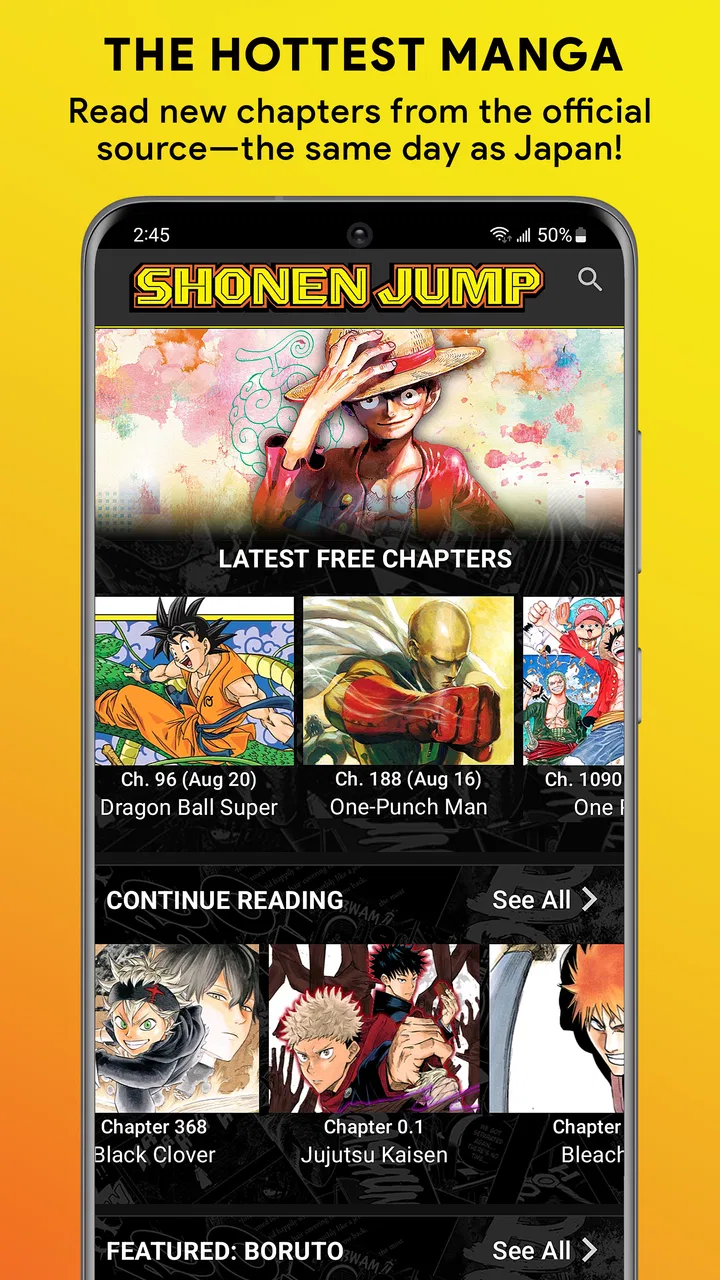
I found Shonen Jump Manga & Comics most compelling when I treated it as a focused reading shelf rather than a general comics marketplace. It is an official manga app from Japan, developed by Viz Media, and its strongest quality is the directness of that purpose: open it when you want Shonen Jump material, choose a series, and get back to reading without wandering through unrelated entertainment. After spending time with it, my view is clear: it is an excellent fit for readers who already know they enjoy major shonen manga, while people looking for a broad, platform-neutral comics library may find its selection and reading model too specialized.
The app is free to install, which makes trying it fairly easy, although in-app purchases range from $0.99 to $19.99 per item. That distinction matters. I would not judge it simply as a free reading app, because the real value depends on how much of its available catalog and reading experience suits your habits. The free entry point is useful for sampling, but a regular reader should think about whether buying individual material fits better than using another service with a wider all-you-can-read approach.
Why its focused manga experience works so well
The first thing I appreciated was the app’s clear identity. It is not trying to be a universal home for every kind of comic. Its store short description is simply “Shonen Jump,” and that narrow promise is reflected in the way I approached it. Instead of spending time comparing unrelated genres, I could concentrate on the kind of long-running action, adventure, rivalry, comedy, and dramatic storytelling associated with the Shonen Jump name.
You May Also Like

 Blood Strike: 2.5 Anniversary
Blood Strike’s Loadouts Turn Every Drop Into a Tactical Gamble
A close look at Blood Strike’s custom loadouts: how fast access to signature weapons reshapes its battle royale rhythm, rewards preparation, and narrows the gap between fights.

 Pandora - Music & Podcasts
Pandora’s Music Is Easy to Start, but Harder to Recover
Pandora’s strength is its low-effort path from a seed to a station. Its weak spot is how much confidence it asks you to place in connection, setup, and quiet recovery.

 8 Ball Pool
 Is Built on Rivalries, Rematches, and Routine
A close look at the rivalries, rematches, shared routines, and unanswered safety questions that turn a quick pool match into a persistent mobile community.

 Samsung Music
’s Quiet Strength Is Playing What You Already Own
Its reach comes less from spectacle than from dependable access to a personal library. That simplicity is both the app’s strongest retention engine and its ceiling.

 AccuWeather: Weather Radar
AccuWeather Review: A Quick, Clear Forecast for Everyday Decisions
For everyday plans, the best forecast is the one you can understand quickly. AccuWeather makes rain timing, radar, and local conditions easy to act on, with a few trade-offs.

 Hill Climb Racing
Why Hill Climb Racing Still Turns Crashes Into One More Run
A tiny car, a bumpy hill and one more upgrade: Hill Climb Racing keeps resurfacing because its simple chaos makes every near-miss feel personal.
More From Our News Desk
View All News


That focus is valuable for a reader who already has a reading list. If a friend tells me to catch up on a particular series, I want an app that makes the search feel purposeful. A specialized catalog can be easier to use than a larger service where manga sits beside superhero books, independent comics, graphic novels, and miscellaneous digital content. In this case, the brand itself acts as a filter. It helps set expectations before I even begin reading.
The app also benefits from being tied to Viz Media rather than presenting itself as an anonymous collection. The “Official from Japan” positioning gives the experience a sense of legitimacy that matters to manga readers who care about using an authorized source. I see that as more than a slogan: it affects how comfortable I feel making it part of my regular reading routine. For someone who wants a recognized publisher connection instead of an improvised scan-reading solution, this is a meaningful advantage.
Reading manga on a phone is not automatically comfortable, so the actual workflow matters. I found the best results came from using the app for deliberate sessions rather than trying to replace a physical volume in every situation. A quiet evening, a commute with reliable access, or a short break is where the format makes sense. The phone keeps a series close at hand, and the focused catalog reduces the time between deciding what to read and opening a chapter.
There is also a practical benefit to keeping a dedicated manga app separate from general reading tools. A standard ebook application may handle pages well, but it usually does not give a reader the same sense of entering a manga-specific space. Conversely, a broad comics subscription may offer more variety but can make it harder to follow a particular publisher’s line. Shonen Jump Manga & Comics sits between those choices: more purposeful than a generic ebook shelf, but narrower than a broad digital comics service.
A good fit for planned reading, not random browsing
My strongest recommendation is for readers who arrive with intent. If you are following a series, exploring well-known Shonen Jump material, or trying to build a manga habit around one recognizable publishing identity, the app feels coherent. I could imagine using it on a Sunday evening to decide which chapter to read next, then returning during the week for short sessions rather than treating it as an endless feed.
That same focus can be a weakness for casual browsers. When I want to discover something completely outside the Shonen Jump orbit, a general comics platform is likely to be more useful. The app’s value is not that it replaces every other comics service; it is that it gives a particular kind of reader a more direct route to a particular kind of content.
One useful habit is to separate sampling from collecting. I would first use the free access to see whether the app’s catalog and reading rhythm match my interests. Only after finding series I genuinely intend to continue would I consider an in-app purchase. This prevents the common mistake of paying simply because a title is familiar. A famous name is not automatically a good match for every reader, and a specialized app rewards a little planning.
What the rating and adoption suggest
The public response is unusually strong, with a 4.9 average from around 80 thousand ratings and over 1 million installs. Those figures do not prove that every reader will enjoy the app, but they do suggest that the central experience is landing well for a substantial audience. I read that response as confirmation of the app’s basic proposition: people who want official Shonen Jump manga appreciate having a dedicated place for it.
There are also around 5.3 thousand written reviews, which indicates that users have been willing to describe their experience rather than merely leave a quick score. I would still treat ratings as a starting point, not a substitute for checking whether the catalog, purchase approach, and phone-reading format fit your own needs. A highly rated specialized app can remain the wrong choice for someone whose tastes are spread across many publishers.
The app has been available since Aug 21, 2013, so it is not a new experiment. That longevity matters to me because it makes the product feel established rather than temporary. Its current version is 4.11.5, and it supports devices running Android 6.0 or newer. Anyone using an older phone should check compatibility before planning around it, while most readers with a reasonably modern Android device should find the operating-system requirement straightforward.
The limitations I would consider before committing
The main friction is the boundary between a free app and a paid reading service. The initial download costs nothing, but the presence of in-app purchases means I would not install it assuming that every desired reading option will remain free. The price range, from $0.99 to $19.99 per item, is broad enough that purchase decisions deserve attention. A small one-off purchase may feel easy to justify, while a larger item requires a clearer idea of how often I will return to it.
This structure can be less convenient than a subscription model for readers who move rapidly between many series. If I want to sample dozens of titles without thinking about individual purchases, another comics service may offer a smoother mental model. On the other hand, readers who prefer paying for specific material rather than maintaining a recurring subscription may appreciate the control. The better option depends on whether your reading is selective or expansive.
Screen size is another real consideration. Manga pages often rely on panel arrangement, small dialogue, and visual pacing, and a phone can make those details feel cramped. I found that I enjoyed the experience more when I slowed down and held the device at a comfortable distance instead of trying to rush through pages. Readers with vision difficulties or a strong preference for large-format art may still prefer printed volumes or a larger screen.
That does not make the app poorly designed; it is a limitation of the reading context. A phone is convenient because it is portable, but portability comes with a smaller canvas. I would choose the app for carrying a series with me, then choose physical books when I wanted a more immersive session. Treating those formats as complementary worked better for me than expecting one to replace the other completely.
The Teen content rating is also worth taking seriously. Parents should not assume that a familiar animated adaptation automatically makes every manga title suitable for a younger child. The rating signals that the intended audience is older than children’s comics, so I would review the specific series and make the decision based on the reader’s age and maturity. For teen and adult manga fans, the rating feels consistent with the type of storytelling associated with the brand.
Where other options may be better
If your priority is the widest possible mix of publishers, genres, and formats, I would look beyond this app. A general digital comics platform may be better for someone who alternates between manga, American comics, independent graphic novels, and webcomics. It can be frustrating to open a specialized app expecting a universal library, only to discover that its greatest strength is also its boundary.
If your priority is collecting books for a shelf, physical volumes remain more satisfying. I like the convenience of digital reading, but it does not provide the same tactile sense of ownership or the same visual scale. If you mainly read at home and already buy print editions, this app may work best as a portable companion rather than your primary format.
For someone who wants to read only occasionally, the purchase model may also be more than they need. A casual reader might prefer borrowing from a library, buying a single print volume, or using a broader service already installed on their device. I would recommend this app more confidently to a person who expects to return to Shonen Jump material repeatedly, because repeated use is what makes a dedicated catalog feel worthwhile.
Practical ways I would use it
My first workflow would be a trial evening: install the free app, choose a series that already interests me, read enough to judge the page experience, and note whether the available purchase path feels natural. I would make that decision before building a large reading queue. This is a simple but useful safeguard, especially for readers who are easily tempted by familiar titles.
My second workflow would be travel reading. I would open the app before leaving, confirm that the chosen material is ready in the way the app expects, and avoid relying on a weak connection at the exact moment I want to read. The important insight is to prepare around the reading session rather than assume that a phone app removes every travel inconvenience. That small bit of planning makes the experience feel much more dependable.
My third workflow would be alternating digital and print. I would use the app for catching up during short breaks, then buy or borrow physical volumes for favorite arcs and longer weekend sessions. This approach takes advantage of portability without asking the phone to deliver the best possible presentation for every page. It also helps control spending because I can reserve purchases for stories I know I want to keep.
Finally, I would use the app as a focused discovery tool, but not as my only source of recommendations. Its identity can point me toward a recognizable style of manga, while friends, library shelves, and broader services can expose me to work outside that lane. That balance prevents the catalog’s specialization from becoming a reading rut.
My recommendation after using it
I recommend Shonen Jump Manga & Comics to readers who want an official, publisher-focused home for Shonen Jump manga and who are comfortable judging purchases title by title. The app’s high average rating, large user base, long availability, and Viz Media connection support the impression that it has become a dependable choice for its intended audience. More importantly, the experience has a clear purpose instead of trying to satisfy every kind of comics reader at once.
I would be more cautious about recommending it to someone who wants one app for all comics, dislikes in-app purchasing, reads mostly on a large screen, or expects a free catalog with no spending decisions. Those readers may be happier with a broad subscription service, library borrowing, or print books. The Teen rating also means parents should choose titles thoughtfully rather than treating the app as automatically suitable for children.
For me, the decisive strength is the combination of focus and convenience. I can keep a Shonen Jump reading habit close without carrying multiple volumes, and I can approach purchases deliberately instead of committing blindly. The decisive weakness is that the phone format and item-based spending model require more personal judgment than a simple all-you-can-read service.
In the end, I see this as a strong specialist app rather than a universal comics solution. If a friend told me they were already interested in Shonen Jump and wanted an official mobile reading option, I would point them toward it and suggest starting slowly with the free experience. If they asked for the broadest catalog or the most book-like reading experience, I would steer them elsewhere. For the right reader, that clarity is exactly what makes Shonen Jump Manga & Comics worth installing.
FAQs for Shonen Jump Manga & Comics
01What is Shonen Jump Manga & Comics?
Shonen Jump Manga & Comics is an app that provides access to a vast library of popular manga series, including titles like "One Piece," "My Hero Academia," and "Naruto." It offers both free and premium content, allowing users to read the latest chapters as soon as they are released in Japan.
02Is Shonen Jump Manga & Comics free to use?
The app offers a combination of free and paid content. Users can read the latest chapters of popular series for free, with new chapters available every week. For access to the entire manga library, users can opt for a subscription, which provides unlimited reading of past chapters.
03What devices support Shonen Jump Manga & Comics?
Shonen Jump Manga & Comics is available for both Android and iOS devices. Users can download the app from the Google Play Store or the Apple App Store. It's optimized for smartphones and tablets, ensuring a seamless reading experience on a variety of screen sizes.
04How often is new content added to the Shonen Jump app?
New chapters are typically added weekly, coinciding with their release in Japan. This means users can read the latest installments of their favorite series almost simultaneously with Japanese audiences. Special editions and additional content may be added periodically.
05Does Shonen Jump Manga & Comics offer offline reading?
Yes, the app supports offline reading for subscribers. Users can download chapters to their device and enjoy reading them without an internet connection. This feature is particularly useful for those who wish to read on-the-go or in areas with limited connectivity.
Pros
- Extensive manga library available.
- Regularly updated with new chapters.
- Offline reading for convenience.
- User-friendly interface design.
- Affordable subscription options.
Cons
- Limited free content availability.
- Requires constant internet for updates.
- Some translations may be inconsistent.
- Ads in the free version are intrusive.
- No dark mode option available.

Shonen Jump Manga & Comics
Gallery